
The monk in us is not some hooded little somebody who is sitting in there, but is our true self, see. …For heaven’s sake, don’t allow the monks to steal the contemplative life from you.
Br. David Steindl-Rast
Welcome to Day One of Discover Your Inner Monk
Imagine yourself walking among the bright yellow lanterns that bedeck the gardens of Tu Hieu Pagoda in Vietnam or pausing to read the Greek words “healing place for the soul” as you enter the breathtaking library at St. Gall Abbey in Switzerland. Or perhaps you can envision yourself in quiet contemplation, gazing up at the soaring sandstone cliffs so perfectly framed by the chapel windows at Christ in the Desert Monastery in New Mexico. Each of these monastic spaces — across continents, traditions, and many years — was created to encourage essential aspects of monk life: solitude, good work, beauty, stillness, study, community, and transcendence. In a kind of reciprocal relationship, the monks’ desired way of living shapes the design of a monastery’s cloisters, chapels, libraries, kitchens, and gardens; these physical spaces, in turn, create the conditions in which monks can contemplate, study, and work with intention.
Most of us don’t live in monasteries, but as Br. David Steindl-Rast says, “Even those who neither want nor can go to a monastery can create for themselves their own little monastery.” This necessary personal monastery is a time and place dedicated to slowing down and getting centered in our own hearts. “This is the process,” he continues, “in which we find the monk within ourselves.”
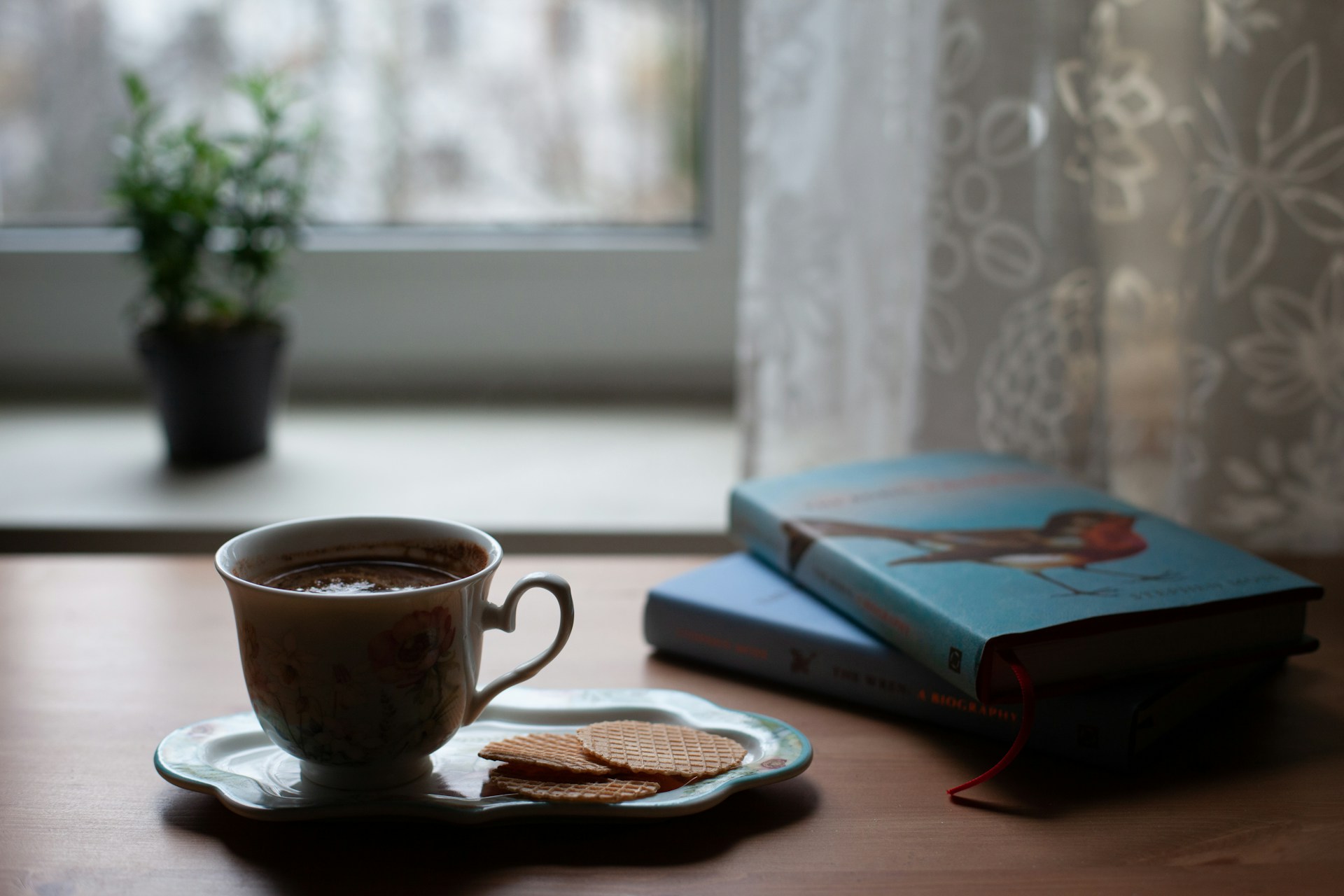
Whether it’s your favorite chair by a window, a garden you love, a place of worship, or some other space, the goal is to create a “whole little cosmos” in which your true self can come to the foreground. This is a space in which you can step away from the noise of the world and listen with and to your own heart. In their book Radical Hospitality, Lonni Collins Pratt and Fr. Dan Homan write, “Listen, the ancient monk tells us, listen. It will break your heart, but it will also give you a heart. And it will give you more — it will give you life.”
Today’s Practice: Create a Little Monastery
To set the stage for today’s practice, enjoy this 2-minute video from the Rubin Museum’s Sacred Spaces exhibition. As part of the project, they asked museum visitors to share what spaces are sacred to them. Over 8,000 people responded, offering wildly diverse ideas for how and where we can create sacred space.
Step One: Choose Your Location
Choose a low-trafficked place in your home or somewhere you like to go that you could begin to think of as a monastery for your heart. This can be as simple as a comfortable chair in your living room or a bench outside your work place. Choose a location where you can claim a bit of solitude. If a physical space isn’t possible, draw on your memory to envision a space you can consistently return to in your mind.
Step Two: Make It a “Place Set Apart”
Fr. Ron Rolheiser writes, “A monastery is not so much a place set apart for monks and nuns as it is a place set apart (period).” For this second step, take a moment to consider what simple enhancements will establish your chosen spot as a “place set apart.”
Here are a few suggestions to consider:
- Clear the space of distractions
- Add a candle, a treasured object, a special cloth, a chime
- Let others know: Since your personal monastery probably won’t be recognizable as such to anyone but you, you may need to let people know, for example, that the blue chair in the corner of the living room is going to be your personal monastery at 7:00 each morning!
Step Three: Listen
Set aside 10 minutes sometime today to sit in stillness in this monastery for your heart, whether you sit in silence, attune to nature’s sounds, or choose meditative music to accompany you. Inspired by Br. David’s reminder that it’s in this kind of space that we can invite our true selves to the foreground, use the following two questions for guided contemplation during your 10 minutes:
- What does my heart know that I need to hear?
- What does my heart need from me?
Looking Ahead
If possible, return to this monastery for your heart — this particular physical or imagined space — for each day’s reflection and practice this week.
Scroll to the bottom of the page (or click here) to find the Community Conversation space where we invite you to share your reflections about today’s practice.
Deepening Resource
In this 4-minute video, Br. David speaks about the benefits of having a physical space that’s conducive to quiet, as it “makes it easier to go into the inner stillness.” He adds, “When you really go deep inside you come in contact with something that goes beyond words and you cannot really describe it.”

Research Highlight
A bit of intentional quiet solitude — distinct from loneliness — offers numerous psychological, emotional, and physical benefits. It helps us know ourselves, allows us to metabolize information, and even boosts creativity. Quiet solitude has also been shown to lower blood pressure, decrease cortisol levels, and stimulate brain growth. Dr. Samantha Stein writes, “Time in quiet solitude can be invaluable in nurturing our relationship with ourselves as well as replenishing us for when we return to the rest of our lives. It’s undoubtedly an investment worth making.”
Stein, Samantha. “The Benefits of Quiet Solitude.” Psychology Today, January 22, 2025.
Photo by Tessa Terrus
Benedictine spirituality has informed and formed me from the early days of my spiritual journey of forty-five plus years. I commit anew – “always beginning again”. I am easily distracted. So again I begin – early mornings In my sacred space – my “snug” , journal and nature walkabouts.
“I’m calmer and more ready to act after I have gone inside” says Br David. This reminds me again of the dance between the contemplative me and the activist me.
When I show up for my date with my inner monk, something almost always happens. I put pen to paper and glimmerings of insight appear and there is calm in my heart.
I am a day late and am so touched how many of us want/need ,to feel loved. 63 years ago I was a contemplative Benedictine and somehow the love has never flagged…only my attention has. thank you for these days. thank. you
My heart knows what I need to hear: I am with you- in you- with every breath. I am Holy Presence
What my heart needs: When distractions come, keep coming back to me .
What ny heart needs to know: I am at one with you
What my heart needs to hear: I love you
Good Morning fellow travellers
From the 10 min sit in quiet space.
Reflections from Today’s Questions.
What my heart needs to know? The space to find peace with impermanence and uncertainty.
Heart needs to hear? I’m here for you…
You don’t need to be perfect. Just be.
Things to do but no need to rush.
Prayers for all on this journey, all around the world and for all beings.
The joy of autumn, children playing in the school field nearby, leaves falling.
It’s time for dinner and i just got my first prompt. I have 5 DAYS to become a monk. Heavens,
where am I most myself? Indoors . this week. I’ll find someplace after dinner. My heart needs to have a good talk with me, that’s for sure.
Send me your blessings Please.
Joyce
You are right where you need to be, Joyce. Tender peace.
I find contentment, peace and calm walking a mile long gravel path near me almost every day.
Squirrels, birds, and the occasional bunny dot the landscape along my route, as well as a rare visitation of elk
There is joy in observing wild native brush, manzanita, oak, and pine trees galore.
I find God within nature.
You chose this location for a reason. (It’s a long way from Long Beach.) The natural world is your monastery. You are definitely in the right place for your Self.
I can call upon the Universe anytime,
anywhere,
but my studio
is where I write
and connect most purposefully . . .
it is where,
as Martin said,
“where I encounter myself…”
and also where I dare to be most honest with myself.
My heart knows
that there is still much I need to let go of . . .
things that cling to my ego
and attach themselves to my identity.
I am releasing some as I become aware of them,
but others
are harder to let go.
My heart
needs for me to let them go.
I rationalize
and say,
‘but I need them’ . . .
things like memories and mementos,
I’m just not ready to let some of them go yet.
I hope
that in the next few days
a door will open,
even if just a crack
to help me admit what is of value
and what is not. ♥
ps. I am enjoying everyone’s reflections
today
and looking forward with humility
to hearing more
as you share your wisdom.
Each morning as I practice from reading to listening, reflecting and journaling the focus begins with “what condition did arrive I in” ” The two questions from today I know will enable me to explore deeper. The answers for today were to hear I am beloved and to feel a sense of belonging
My sacred space can be anywhere i can sit still and quiet for 20 minutes. Sometimes by my kitchen table; sometimes in my chair in sunroom; and yes I’m Blessed enough to live and work in a real Cistercian Monastery so quite often its there!
My challenge is to let my Heart be fully open to God whom I believe lives within my deepest self.
My chosen sacred space is in my bedroom next to a window which looks out our backyard where birds often gather. I crack the window and hear nature speak. I sit in a rocking chair I junk picked and refinished nearly 50 years ago. I lit a candle and sat quietly with my eyes closed for 8 minutes. I let my mind go into a trance like state. My body feels relaxed. I open my eyes and see the golden leaves on a tree in the side yard. Life is so precious.
Ah, life is so precious. That grabbed my attention. Thank you.
After a weekend of much needed rainfall, today is a gorgeous Autumn day with bright blue skies, orange, yellow and brown leaves on the trees simply and all is simply aglow in the bright sunshine. I’m sitting in my living room with a candle lit (the candle is named “I am Thankful”) and the aroma is filling the room. The quietness is awesome, looking outside into the Autumn weather all around my soul is filled, actually bursting, with joy for this season! I am filled with gratitude, joy and thanksgiving. I am so blessed. I am loved. I am God’s beloved son. I am grateful! Thank you!
The candle is named “I am Thankful” made me smile.
My living room is as tall as it is wide, two-stories with windows that peer out at tall trees both in front and back, allowing me to be at one with nature in my home space. It is a very quiet street and our home backs up to the Tonto National Forest. This spot feel like my sanctuary. The sun shines in the windows today, lighting up the yellowing ash tree leaves. When it is clear at night, the full moon appears in the front upper windows crossing the blackness. I feel at home seeing the sky and the trees and the moon from my seat in the living room.
I’m grateful to give myself a moments peace, and hope to continue tomorrow
I live alone, so it is not difficult to find a space. It’s a little more difficult to avoid distractions, but that’s why I’m here. My sacred space is a chair in my living room where I don’t usually sit, where I can see outdoors. Sitting is stillness is easy, because I’m a Quaker!