

Time and space are interrelated. To overlook either of them is to be partially blind.
Rabbi Abraham Joshua Heschel
Welcome to Day Two of Discover Your Inner Monk
Is there a part of you yearning for a life where the turning of the seasons or the ringing of beautiful bells would replace project deadlines, appointments, or traffic jams? Or perhaps you wish that your days were punctuated by more meaningful work, connection, or contemplation? If life feels too busy or too slow, too full of work or too empty of the purpose you seek, taking simple steps to sanctify your time can make space for your inner monk to thrive.
Reflecting on her time in a Benedictine monastery, Kathleen Norris writes, “Gradually my perspective on time had changed. In our culture, time can seem like an enemy: it chews us up and spits us out with appalling ease…The Benedictines, more than any other people I know, insist that there is time in each day for prayer, for work, for study, and for play.” In this way, monastic life offers a model we can learn and borrow from, beginning with the awareness that time is a gift.
Sanctifying time takes intention and discipline. It requires us to assess how we’re spending our hours and days, and then begin to make whatever adjustments are available to us, in both attitude and action, to cultivate the monk within. Sanctifying time is a powerful response to broader cultural influences that reward busyness and offer endless distraction, and it doesn’t require moving to the monastery. Instead, it can begin with reclaiming a few moments for the reflection, connection, prayer, good work, or play that is missing from your daily life.
Today’s Practice: Honor the Gift of Time
Set the stage for today’s practice by listening to this beautiful Broadway classic that asks the powerful question, “How do you measure a year?” The song reminds us that we have 525,600 minutes in each year we live but that there are more meaningful ways to think about and measure our time, including by our journeys, laughter, strife, and love. How do you structure and measure your time?
Step One: Do a Time Audit
Draw a vertical line down the middle of a sheet of paper. On the left, make a list of some things you’d like to give more time to (activities, people, ideas!). On the right, make a list of things you’d like to dial back. As you make your lists, try to free yourself from judgement; naming that you want to give less of your time to something, for example, isn’t so much a measure of its importance as it is a way of working toward that balanced life that your inner monk is longing for.
Step Two: Listen to the Monk Within
As you review your lists, what does your inner monk have to say? Use the following questions for guided reflection:
- Am I responding to time as the gift that it is?
- Does my time usage feed my soul?
- Am I making time for “prayer, work, study, and play” — however I define each of these?
- Where could I use a little courage to release something?
Step Three: Make a Small Shift
Circle two things, one from each column, where small adjustments to your time allocation are achievable today. These should be simple: “I’m going to read a book or listen to music for 10 minutes while having my tea” or — inspired by today’s deepening resource — “I’m going to build in 5-minute transitions to give thanks between the different activities of my day.” Commit to two, and see how you do. If something works, continue it throughout the week or even beyond.
Scroll to the bottom of the page (or click here) to find the Community Conversation space where we invite you to share your reflections about today’s practice.
Deepening Resource
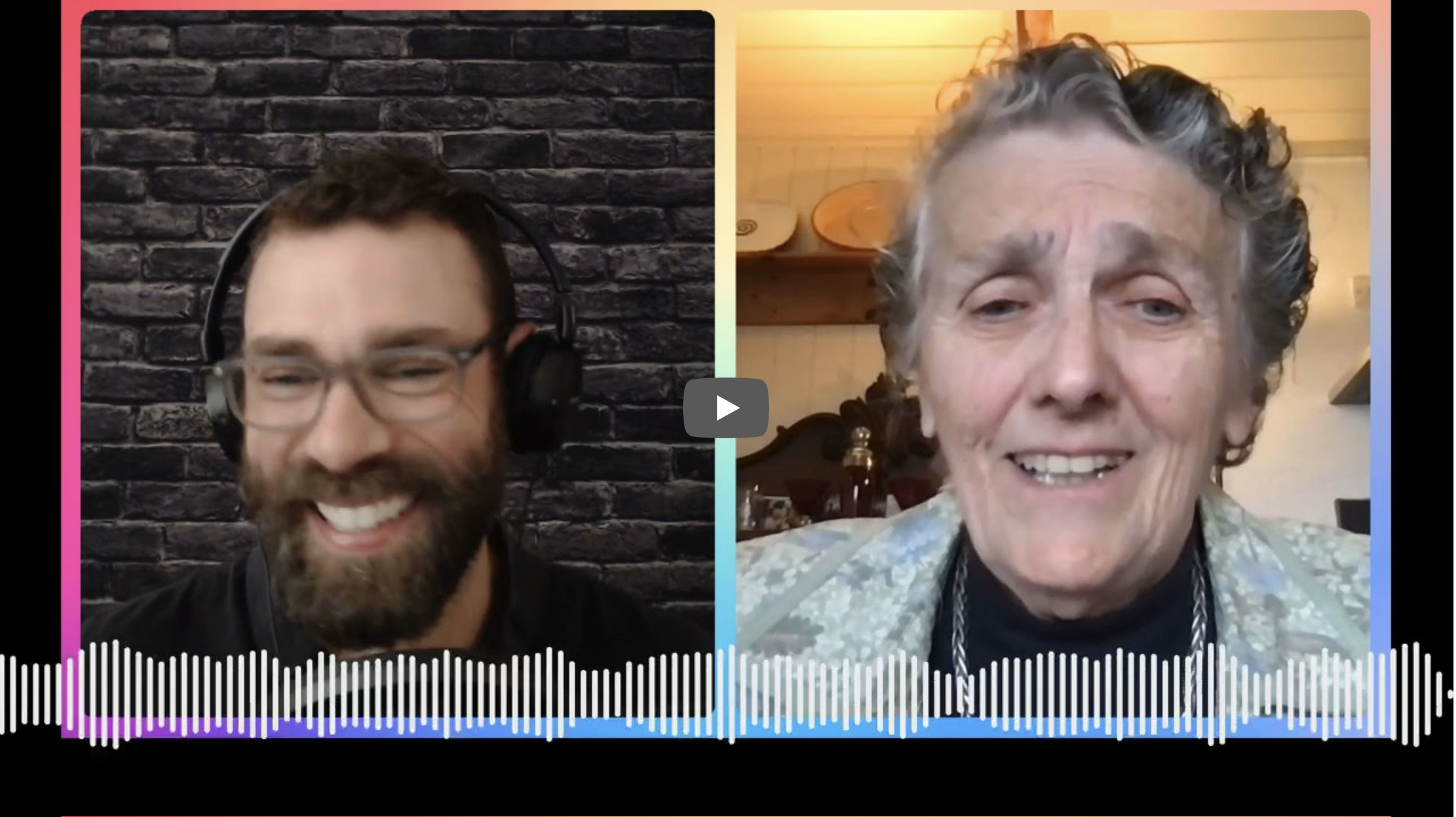
Take inspiration from this conversation between UMC podcast host Ryan Dunn and Benedictine Sister Joan Chittister. In particular, listen closely to minutes 13:15–17:30, in which Sister Joan explains the concept of statio in Benedictine monastic life — the idea of a holy pause between activities. Consider how you could build a practice of statio in your life as you move from one thing to another throughout your day.
Research Highlight
In a meta-analysis of 53 studies across 32 countries, researchers found that disruptions in daily routines were associated with higher levels of depression, anxiety, and psychological distress. The associations were especially evident for regularity in things like sleep, eating, and physical activity. In a separate set of studies about the impact of small rituals, subjects who added a simple ritual to meal times experienced the food as more enjoyable, valuable, and worthy of savoring. Combined, these studies make a strong argument that developing some consistent routines, supported by small rituals that deepen our engagement with ordinary experiences, can help us sanctify time in our everyday lives.
Liu, H., T. J. Tao, S. K. Y. Chan, et al. “Daily Routine Disruptions and Psychiatric Symptoms amid COVID-19: A Systematic Review and Meta-Analysis of Data from 0.9 Million Individuals in 32 Countries.” BMC Medicine 22 (2024): 60.
Vohs, Kathleen D., Yajin Wang, Francesca Gino, and Michael I. Norton. “Rituals Enhance Consumption.” Psychological Science 24, no. 9 (2013): 1714–1721.
Photo by Koko Htikeaung
The distraction of my cell phone is a time-waster! I need to just put down the darn thing. I’m going to devote the time saved to accessing my Inner Monk and living a life with more intention and presence. Sister Joan is wonderful!
I loved the song video!! It had me remembering that time is the most precious gift we have. On my list, I circled “the phone”; I acknowledge it is an easy escape and a huge waste of time.
I loved how Sr. Joan explained statio – today’s gifts (Day 2) hit home deeply for me.
I am so glad I signed up for the inner Monk.
I’m trying so hard – to sanctify my time. I started this morning before receiving today’s lesson.
A very worthwhile opportunity was presented to me. I thought it was to participate in a small group on an important topic. One that would make me concentrate and learn. Then I realized that the offer was not to participate, but to facilitate one or all of the gatherings. In the past I’d have said yes even if I meant no. Or I’d have squirmed about it for a week, practicing no.
I am so far behind in life. In my spiritual practices. In my housekeeping, yard work and chores (I’m a widow). In my business upkeep. In my art goals and writing dreams. And mostly in everyday important details that don’t ever let up.
I chose peace today in anticipation of needing that peace. This is a mad, mad world we live in and I sense that we are all struggling in some way. I can only help the world by keeping a quiet, burning light inside my own soul. Today that meant simply declining the opportunity presented to me. “I can’t right now. Maybe in the future.”
I want to celebrate the sanctity of time by honoring it deeply. I hope you all can, too.
more metanoia , less paranoi 🙂
Today is my birthday and watching the music video moved me in a way that made me desire to be more intentional about how I am sharing connection,, love and life with others.in my life and community.
I hope that your day is filled with laughter and love and that all of your birthday wishes come true.
Today is my birthday and watching the music video moved me in a way that made me desire to be more intentional about how I am sharing connection,, love and life with others.in my life and community.
I am committing to more statio (holy pause of thanks & then self settling) between activities and fortifying my heart with love instead of entertaining worry or unwanted advice for loved ones.
I want to take a break outside daily just to breathe and enjoy what I’m seeing.
The whole podcast with Sr. Joan was amazing, but her reflections on statio were extraordinary. They were a vivid reminder of the practice of “stop, look, go”, which I can bring to all of the transitions in what I am doing in order to fully arrive and engage. Day 1 and 2 were wonderful practices to help me sanctify space and time. Thank you.
Today I commit to reading the Gospel of the day and pondering it!
Tonight I commit to not using my phone in the hour before bed!
They’re my two ‘circled’ commitments to improving my precious ‘time’!!
Time is a precious gift, and I must find the energy to use my afternoons and evenings to nourish my soul. I intend to create more ritual around evening dinner with my sweetie. Now that we are empty-nesters, we often bypass this sacred time in favor of a “quick fix” and distraction: cereal and Netflix. We can do better 💜 🍜!
After all that BS I didn’t say what I meant to say…the practice I am offering is to mindfully correct my typing on my phone. I was making much less errors for a long time and now I am back to making lots of errors, cursing, re-typing. I pledge to do what it takes to mindfully type; make less errors; not curse when I make them; demonstrate nonduality, rather than preach about it. Amen. Thank you for your patience. Thank you for this opportunity. May this not sound/appear like a diminishment of the sacred task
we are about.
After reviewing my time audit list, I wrote: “I guess my inner monk at this season of life is craving more unstructured time at home and in nature!”
It is day two and I am venturing to write [Tom, why are you writing? Is it to see your thoughts in print? To promote yourself? I’ve watched you observe the “likes” and the “replies;” a la social media.]
I am “resisting,” ‘find a space’; ‘set aside a time.’ As a non-dualist (Thank you in advance for not asking what that means (-:)) I am hesitant to separate. Can I be present in this moment; not present in that – or is it that I am present or I am not?
And yet I have ‘altar’ spaces; times I do ‘this’ and not ‘that.’
???
I am reminded of “pilpul’ – the Talmudic tradition of “arguing a point as scholarship.” (Which in itself has strengths and weaknesses).
And then there is the quiet…the great mystery…beyond all that…
One of my favorite songs!!!