
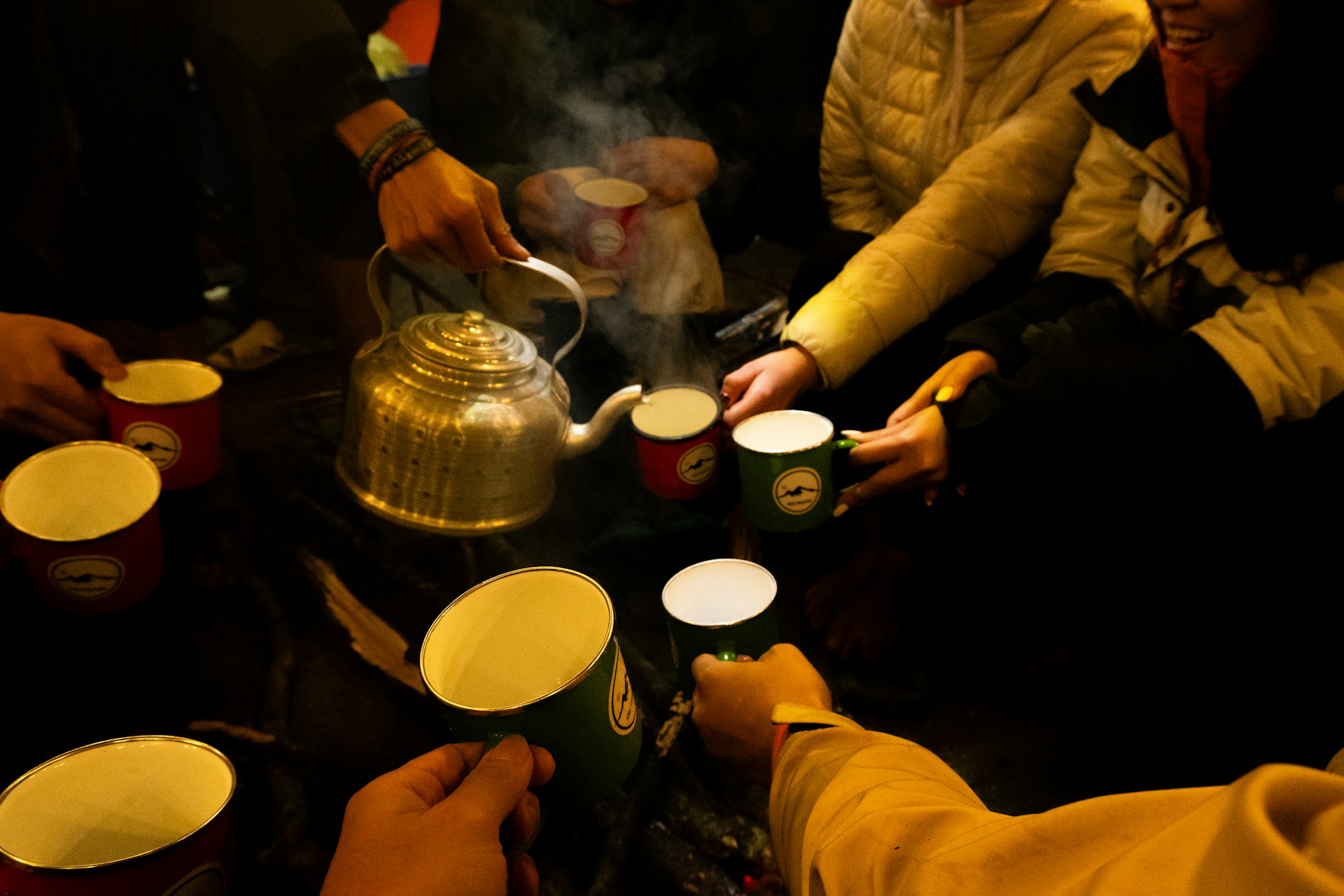
The contemplative life is not, and cannot be, a mere withdrawal, a pure negation, a turning of one’s back on the world with its sufferings, its crises, its confusions and its errors.
Thomas Merton
Welcome to Day Three of Discover Your Inner Monk
Monk life centers on meditation or prayer, but it is supported and enlivened by shared work and a palpable sense of community. Monks work in the garden, maintain the library, cook, clean, and create products to help support the monastery: habanero hot sauce, artisanal breads and jams, coffee and beer, to name a few! Together, monks in a monastery build a network of care and support, but this doesn’t end at the monastery walls. As Lonni Pratt and Fr. Daniel Homan write, “Hospitality tops the list of what is valued in a monastery because people are valued, and an equal dignity for all is assumed. Monks view people positively. Every human is sacred; every life is holy ground.”
This view extends beyond the monastery walls. Reflecting on his decision to protest the war in Vietnam and his subsequent lifelong commitment to peace-building, Buddhist monk Thich Nhat Hanh said, “When bombs begin to fall on people, you cannot stay in the meditation hall all of the time.” Phra Pachak Kuttijitto and his fellow monks and nuns in Thailand have led a powerful movement to protect the Thai forests from indiscriminate and illegal logging. Benedictine monastic Sister Joan Chittister calls for social action to secure human rights, with particular focus on equal rights for women. In other words, there’s a responsibility to respond to the crises and suffering in the world.
To put our inner monk to work, it’s helpful, at least at first, to scale our thinking to the village level rather than the global one. Br. Phap Dung describes his teacher Thich Nhat Hanh’s vision of the village way as blending the “spiritual practice of liberation and collective responsibility with active social engagement.” The village way “invites us not only to dream of a better society but also to build it with our hands and hearts.” This begins right where we are, with the people in our families, our communities, and at the margins of whatever “village” we inhabit.
Today’s Practice: See Everyone as Sacred, Every Life as Holy Ground
To set the stage for today’s practice, enjoy this beautiful 5-minute film by Reflections of Life in which Sayibonga shares his version of thinking in the village way. As he describes it, “It’s not about one person in our village, it’s about everyone who lives in the village. The person is the person because of the other people and nature. To be human, you must connect.”
Step One: Adopt a 24-Hour Mantra
To support thinking in the village way, experiment with this simple mantra, borrowed from the Pratt and Homan quote above: “Every human is sacred; every life is holy ground.” If helpful, write it on a post-it or a small piece of paper to carry with you throughout the day. Each time you interact with someone, from family and friends to strangers (as long as you’re physically safe), say this mantra to yourself.
Step Two: Reflect Along the Way
Throughout the day, consider the following questions:
- How is this mantra affirming how I like to think about and interact with others?
- In what ways is this mantra impacting my interactions?
- What feels hard? What feels like a gift?
Step Three: Expand Your Village Borders
Identify one way that you can expand the borders of your “village” by engaging more deeply with a person, group of people, or cause. In order to live by the mantra, “Every human is sacred; every life is holy ground,” identify one new perspective or action you can try out today.
Scroll to the bottom of the page (or click here) to find the Community Conversation space where we invite you to share your reflections about today’s practice.
Deepening Resource
To think in the village way isn’t just thinking about our relationships with other humans; it’s thinking about our relationship with all of life. In this guided meditation accompanied by beautiful visuals, Lama Rod Owens helps us remember the reciprocal, nourishing, and healing relationship with the earth that is available to us. Lama Rod is an authorized Tibetan Buddhist teacher in the Kagyu tradition. While not an ordained monk, his work is shaped by his 3-year retreat in the Kagyu Thubten Chöling Monastery. Enjoy the meditation.
Surrendering to the Earth Guided Meditation with Lama Rod Owens
Research Highlight
Research strongly suggests that becoming a grateful person — possessing what researchers call “trait gratitude” vs. feeling a fleeting sense of gratitude — can boost our capacity to think in the village way. In three large-scale studies across 22 countries, researchers found that people who were dispositionally more grateful were more likely to engage in costly prosocial actions. Gratefulness correlates with concern for the village, even if it requires being uncomfortable or giving something up. This research challenges the idea that being grateful can lead to complacency; instead, it increases concern for the greater good.
Lee, Randy T., Kirstan Brodie, Jerry Richardson, and Thomas Gilovich. “Glad to Help Out: Grateful People Are More Likely to Engage in Costly Prosocial Action.” Emotion, August 20, 2026.
Photo by Hung Pham
This days suggestion is deeply profound. Years ago I heard a mantra that has stayed with me. “I love you, I am honored to serve you”. I am uncertain of the author., it may have been Thich Nhat Hahn but I can’t say for certain. When I say it prior to engaging with others it changes the interaction in lovely ways. Thank you for rekindling the use of mantra in this way.
Years ago, I did a series of classes where each month we would see Jesus in a different light. Jesus as Jew. Jesus as healer. Jesus in a multicultural world. One month it was seeing Jesus as wounded. We were challenged to look at others that way and I recall a nurse’s story of a difficult patient. She was grumbling about having to go in and deal with him, and then she stopped and pictured the complaining patient as the wounded body on the cross. She wept. Since then I have seen everyone differently. Everyone. It has helped me in recent years when I see people I am vehemently opposed to politically. It brings peace to my heart to remember the soul within. Even when I don’t agree with someone, I am able to see them with compassion (Even one I have a very difficult time understanding.) I am pleased with the election results myself, and have refrained from rubbing it in to those with different views.
All holy. .
This is a beautiful practice, thank you for sharing.
Feels good to connect with body and earth in todays offering ( day 3 )
foundational for deeper energy work in/on your heart ( and mind )
The resources from today including both videos speak to me deeply. I find myself floating in reflection related to “Every human is sacred; every life is holy.” This day has been energizing and exhausting for me; may we humans connect lovingly and healthfully no matter our cirmcumstances.
Wow…. The earth meditation with Lama Rod Owens touched my heart, my whole being deeply. Thank you for such a veneration, respect, honor of mother nature. Mother nature is so generous. I need to be generous to her. With care and gratitude… Gladys
The reciprocity of breath –
I breathe in and my body receives what it needs from the earth.
I breathe out and the earth receives what it needs from my body.
I will add this mantra to my breath meditation. Thank you Lama Rod Owens.
This mantra: Every human is sacred; every life is holy”. has been part of my consciousness for 50 years plus. Now in my senior years, in a care home I bless people I meet or those part of my life since my birth. Through memories I revisit and bless. I send blessings as I read your comments’ even those who leave no comments; you too are blessed. I breathe is a gift of this earth and I exhale wrapping you in blessing.
Thank you 💕Breathing blessings right back to you.
Thank you 💕Breathing blessings right back to you.
This mantra: Every human is sacred; every life is holy”. has been part of my consciousness for 50 years plus. Now in my senior years, in a care home I bless people I meet or those part of my life since my birth. Through memories I revisit and bless.
So grateful… here is a prayer I pray daily that I am using as a mantra today… combines a prayer Jesus prayed with a verse from Job… it sings to me for all of us :
And now O Father- glorify me with the glory I had with you before the world was… when the morning stars sang together and all the children of God shouted for joy.
And I cap it with affirming : we are there !
Feels very much in line with Every life is sacred. Every life is holy ground .
Today’s practice affirms my desire to deliberately seek out “the other” and listen/interact with them upholding their dignity, recognizing that their presence is an invitation into a more expansive love. I’m grateful for my “sangha” that nudges me always in that direction.
Today’s meditations and resources
speak to me . . .
I have always believed
that all sentient beings are sacred,
and that every life,
whether we perceive it as life or not
is holy ground.
My mother,
who was a devout Christian
called me a Pantheist . . .
perhaps I am.
I have a rich inner life
and bring what is in me
out where I think it is welcome.
My problem
is physical, hands on community,
as I live a mostly solitary life,
and not a joiner by nature.
I am safe and at peace in my studio
and in my gardens,
but I don’t find what I might seek
in my local community. ♥
Talarico = Make Jesus Understood Again.
Be compassionate to those who aren’t happy with the election and not assume everyone is happy as I am, in my blue neighborhood.
We used to host neighbor gatherings, then one neighbor was arrested for armed assault. Her case had dragged on for two years. She may go to prison. The other neighbors shun her out of fear.We don’t host gatherings anymore. We live in a semi dual area with acres of open land between us. If we host the neighbors and leave her out, she will see it and be hurt,maybe violent?
How can I live a village life here?
Dear Joyce,
Thank you for what you’ve shared here. While I don’t have an easy answer to your questions, I did want to acknowledge the difficulty (and sadness, I imagine) of the situation that you’re in. What a painful disruption to your neighborly gatherings. I do hope that you and your neighbors can somehow find a new, safe, and fulfilling way to gather. I’m holding your story with a lot of tenderness and compassion.
The meditation video is beautiful. Very healing.