
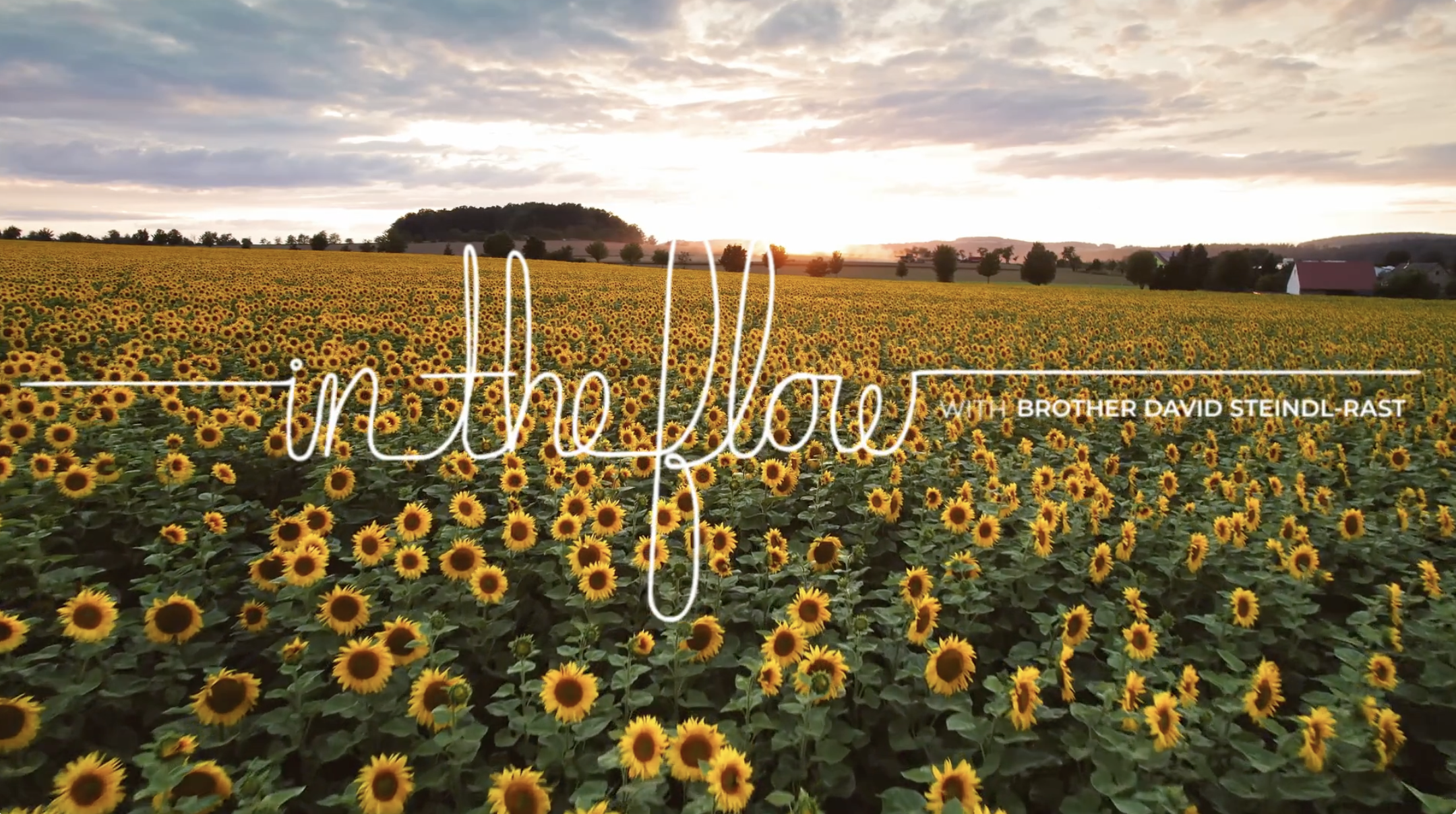
Help us celebrate Br. David’s centennial with a new In the Flow film produced by Sounds True! This meditation includes remarks by Br. David excepted from “Awakening to Gratefulness.” Tami Simon, founder of Sounds True, has lifted up the voices of great spiritual teachers since 1985, including Br. David. In The Flow is a video series of one-of-a-kind meditations and wisdom experiences, featuring acclaimed teachers and spiritual guides. Each offering combines the power of the spoken word with healing music and evocative visual journeys, created by Sounds True One filmmakers.
Video Transcript
One aspect why grateful living and gratefulness is so important is that it is so universal. It’s there in every part of the world. It’s there with children, with young people, with adults, with old people. You don’t have to explain gratefulness. Talk about gratefulness, and everybody know’s what you’re talking about. Even people who don’t have the word gratefulness, there are cultures that don’t have the word gratefulness, but that does not mean that they don’t know what it is all about and that they are not grateful. It may actually mean that they are so much more grateful that they don’t even have the word for it. It’s simply the way one behaves towards one another, and it’s given by the culture. It’s accepted. Nothing else would do. That’s right. That’s how one behaves. Everything else is wrong because it’s the only right response in a given world to be grateful to one another. But to say thank you would almost be like giving a tip to somebody who holds the door open at the supermarket for you…it’s inappropriate. It’s simply accepted. That’s right. That’s how one acts. That’s how humans act to one another. So the word is not so important, but the important thing is that everybody in the world understands what we mean by gratefulness. So that means we have something to build on, to build on a valid spiritual practice. It is in all the spiritual traditions so profoundly grateful and also so expressive. So that universal, every tradition would say, “Gratefulness? Yes, that’s at our heart.” Every spiritual tradition treasures gratitude. So we have a basis for the understanding between the spiritual traditions. What could be more important today than that? We have the spirituality that unites all spiritualities is the spirituality of gratitude. And the practice that is within every practice, every spiritual practice, is also grateful living. It’s something that you can combine with any other spiritual practice. Say you practice Zen. Yeah, you obviously can practice it gratefully. That’s the best Zen. Just be grateful. It’s accessible to everybody. It’s so accessible. It’s what we do every day anyway. You don’t have to add anything in time or place or action. Just live gratefully. And that will do what all the spiritual traditions do because the goal of every spiritual tradition there is, is to make you present in the now. And gratefulness makes you present in the now. It makes you present in the now and so puts your weight into yourself, not in the little ego, but in that self, into your very center. When you are in the now, you are in the self. That’s what gratefulness does because you can be grateful for the past, and you can be grateful for what you expect in the future, but you can only be grateful now in the present. You cannot be grateful in the future because when the future comes, it will be the now, and then again, you are present, grateful in the present. And you can’t be present in the past because the past is gone, and it’s no longer available to you. So whenever you’re grateful, you’re grateful in the now, and that brings you into the now. When you are grateful, everything comes into the moment, and then the next moment, you may already be dispersed into past and future and tied up again. But then when you’re grateful again, it comes into the present moment. And the more you are grateful, the more your weight shifts into this present moment. And that is the goal, as I said, of all spiritual practices, and all spiritual practices will say that. All teachers that I’ve ever met, and I was very privileged in meeting many wonderful teachers of many different practices, and they all said the one important thing is to be in the present moment. And so easy. Just be grateful. And you don’t even have to think about past or present or anything like that. Just be grateful. And there you are in the present moment. So that is one of the most important aspects of why we are to be grateful. Grateful living is a valid spiritual practice among all the other spiritual practices. Practices can be combined with other spiritual practices and brings you into the now where you are truly yourself.
The Anatomy of Gratefulness: Say Yes to Life
Wondering what it truly means to live a grateful life and how to do it? In this on-demand course, learn guiding principles for living gratefully every day, try daily practices that can guide you in challenging and joyful times, explore what scientific research and spiritual wisdom have to say about the benefits of living gratefully, and more.

 Br. David Steindl-Rast
Comments are now closed on this page. We invite you to join the conversation in our new community space. We hope to see you there!