
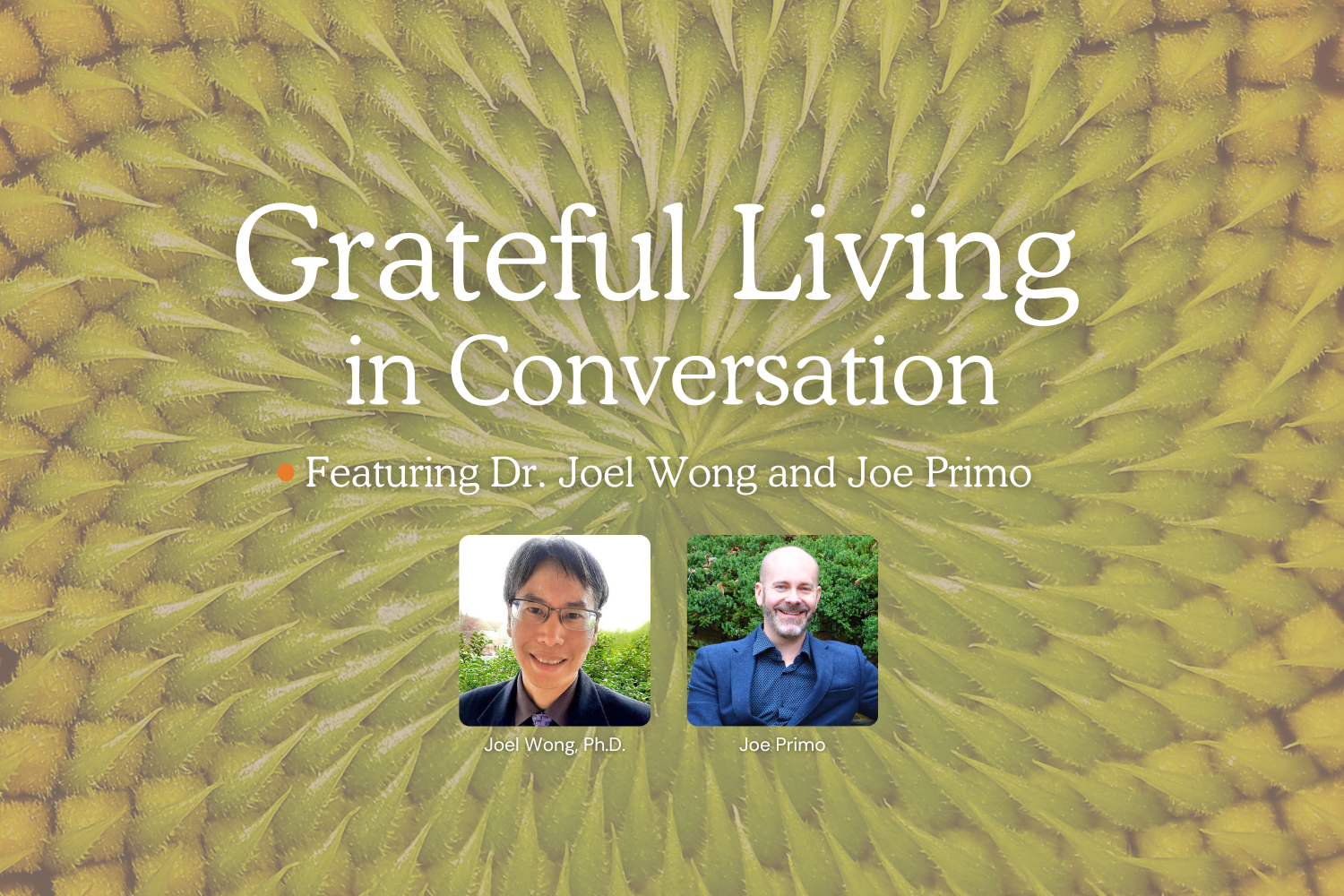
Prone to negative thinking? In this short video, gratitude researcher Dr. Joel Wong shares a simple practice that can transform negative thoughts into opportunities for gratitude.
Enjoy the full 1-hour conversation in our on-demand course, The Anatomy of Gratefulness: Say Yes to Life.
Video Transcript
Joe Primo: This invitation is not for folks who just see sunshine and rainbows, but actually it’s available to everybody no matter what your temperament is. And if you are somebody who is anxious and a worrier, and perhaps a little bit of a skeptic, that actually you don’t have to pretend that that’s not a part of you, that that is another opportunity that you can use for shaping your perspective. And you have a really great acronym around that, that really is where I busted out laughing. Could you talk a little bit about why gratitude is available and accessible to everybody, even the pessimist?
Dr. Joel Wong: Yeah. I think one of the misconceptions and myths out there is that, you know, gratitude is just all about positive thinking. Don’t worry, be happy. And if you’re a pessimist or someone who’s prone to worrying, it’s like, I can’t do that, this is not for me. And for folks out there who are more prone to negative thinking, this is my offer to you or invitation to you that, you know what, you have a superpower that can help you to become more grateful. In fact, I would argue that if you are a hundred percent positive, it actually becomes harder to be grateful because gratitude does require the acknowledgement that the good things in your life are somewhat precarious and fragile. And they’re not always there. They’re not always available. And because they’re a little fragile and precarious, we want to hold onto it and appreciate these good things a lot more than if they were just abundantly available.
So, I’ll give you an example of… a very practical example of what I mean for the people who are pessimists or have negative thinking, right? People who have negative thinking tend to focus on what is bad in the future. If you focus on what’s bad in the future — you know, these things could happen — you might be prone to anxiety. If you focus a lot on what’s bad in the past, you might be prone to depression because you’re ruminating on, if only this hadn’t happened, or, you know, perhaps what’s bad in the present too. But people who are very good at this negative thinking, you could also think in a particular negative way that helps you to be more grateful.
Now, if you want the actual technical term for this way of negative thinking, you know, it’s something you can throw around in cocktail parties. It’s called downward counterfactual thinking. Downward counterfactual thinking. But I have an easier term to use and I call it CBAD. C-B-A-D. It’s an acronym, which I call could have been a disaster. So what I mean by that, I’m going to explain downward counterfactual thinking, which is also what I call CBAD. And CBAD simply means you can think about the bad things that could have happened but didn’t.
And they’re all around us, right? You ran after a bus, you just got on the bus and you almost missed it. But you didn’t miss it. And because you got on the bus, it got you to your appointment on time. And if you hadn’t made the appointment on time, lots of bad things could have happened. Maybe you’re going for a job interview or whatever. And so you are able to think counterfactually… counterfactually just means to think about something that actually didn’t happen, but could have happened, right? And downward counterfactual thinking is saying something bad that could have happened but didn’t happen, and this way of thinking would double the number of things you can give thanks for because we live in a precarious world where beauty and brokenness coexist, right? So you just have to look around at what’s happening in the lives of your friends or people around you or in people outside in the world to recognize these are sometimes horrifically bad things that happened to others. And it’s like, what did I do to deserve it? It didn’t happen to me? So when you reflect on that, that helps you recognize that, hey, I am maybe a bit more lucky than I thought I was, and that there are many things I could be grateful for.
So we are redefining good things in our lives, not simply as something positive that happened, but also as something negative that could have happened but didn’t. So I would encourage all the pessimists out there, try CBAD see as a way to help you become more grateful.
The Anatomy of Gratefulness: Say Yes to Life
Wondering what it truly means to live a grateful life and how to do it? In this on-demand course, learn guiding principles for living gratefully every day, try daily practices that can guide you in challenging and joyful times, explore what scientific research and spiritual wisdom have to say about the benefits of living gratefully, and more.

Comments are now closed on this page. We invite you to join the conversation in our new community space. We hope to see you there!