

There are times in life when we feel most alive and grounded in our existence. It is tempting to seek grandiose experiences that can manufacture this sense of aliveness. But, for most of us, some sort of spiritual rapture is not required in order to feel a deep sense of aliveness. To awaken to the grateful life, we simply need some depth born from practice, intention, and curiosity to illuminate the gift we’ve been given, the gift of embodiment.
I experienced my first awakening to life was when I was fourteen. It followed two previous events in which I almost drowned, once from being caught in a riptide and once from being trapped on an overturned water toy. While those experiences terrified me, I did not recognize the gift of my life in those moments. It took someone else losing their life to awaken me to my own. While on summer vacation with my grandparents, my aunt died at the table as we ate lunch. For months, I was sick and missed much of my freshman year of high school because I was horrified by what I had witnessed. In a millisecond, without warning and between nibbles of a tuna melt sandwich, everything can end. I feel grateful to have gained this understanding at a young age. The knowledge that I only have one life is why the grateful life is my only pursuit and ambition as I age.
Carl Jung said, “We all have two lives. The second one begins when we realize we only have one.” I believe that Jung was describing an intersection that we all arrive at in life. For Thomas Merton, it was a literal intersection at the corner of Walnut and 4th Street in Louisville, KY, where I recently stood myself. There, as shoppers crossed the street, he recalls, “I was suddenly overwhelmed with the realization that I loved all these people, that they were mine and I theirs, that we could not be alien to one another even though we were total strangers. It was like waking from a dream of separateness, of spurious self-isolation in a special world…” This intersection, some 67 years later, is indistinguishable from any other, apart from the commemorative plaque. In its ordinariness, it represents the possibility that every intersection — literal and metaphorical — offers an opportunity to awaken from the illusions of our generation.
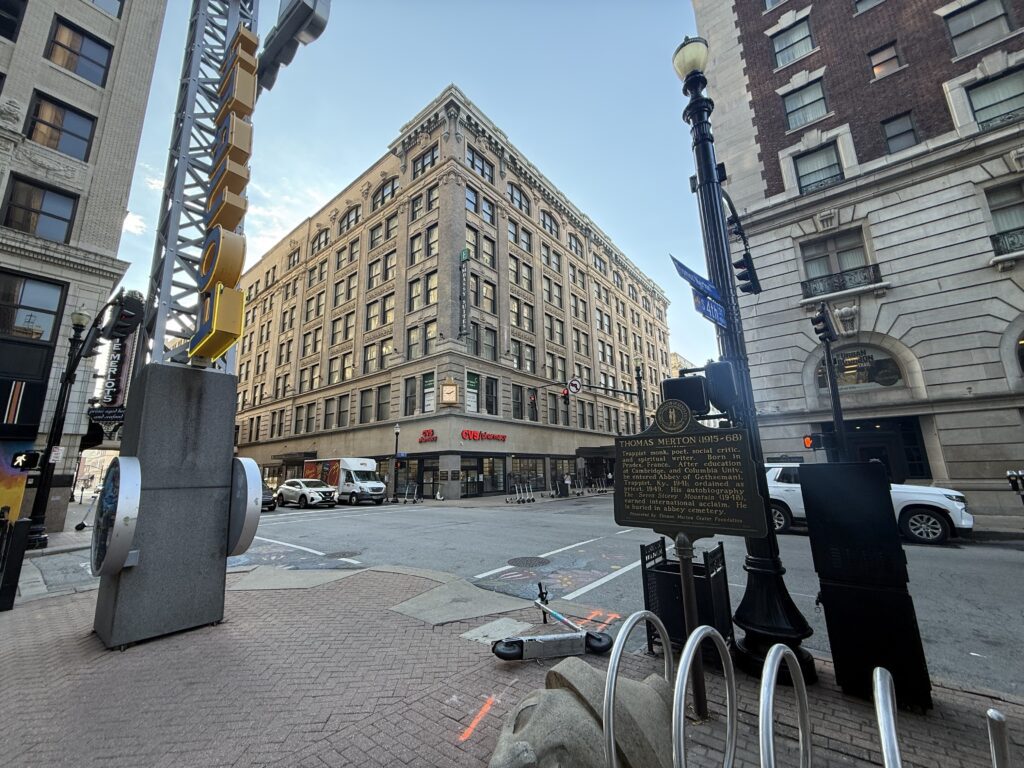
When we arrive at this intersection in life, we have the choice to stay the course or to live gratefully. While I usually find binaries limiting and reductive, I believe this is where we stand when we arrive at crossroads.
In one direction we have a world of promises that caters to our desire for more, better, domination, and control. These foibles of the ego are fed by consuming more than the Earth and laborers can healthily provide, neglecting and impoverishing the stranger, and slowly destroying the self with an intoxicating belief in the power of the individual and its pursuits for perfection and beauty. This is the land of fear and insecurity, where a negative worldview of self and others is normalized and saturates the collective perspective like a tropical storm. This is a road that takes its travelers to a strange place, where contentment and satisfaction are seemingly always out of reach. This is a place where people struggle to live meaningful lives because they are too busy living in an economy of fear and the illusion of separateness. Ultimately, this is not a place one wants to call home once they’ve seen through the illusion and realize, as Jung said, that we have one life to live. The questions we ask ourselves here — am I worthy, do I belong, and am I enough? — never seem to have definitive answers.
In the other direction, living gratefully offers a compass to navigate the norms, complacencies, and entrapments that every generation must confront. This is not an alternative illusion to the ones we inherit throughout life, where worry or difficulty can be erased or denied. Rather, it is a response to life that affirms the gift we’ve been given. This is a route towards contentment and appreciation. It contains an understanding that the uncertainty of life is what makes it pregnant with possibilities. Living gratefully is your roadmap to joy and strengthened relationships because it allows you to become more alive in each moment. This path both requires and provides a spiritual maturity and, as a result, it is an extraordinary filter for shaking off all those aforementioned illusions that cause us to miss out on life.
Choosing a grateful life is not without its challenges, though. In fact, in many ways, it is more difficult. Getting off whatever highway of illusions you find yourself on — the one that wants to take you towards insatiable ambition, or accumulating materialism, or offer you discourse that depletes and divides rather than nourishes — requires courage. When we liberate ourselves from illusions that constrain life, we will have to show up differently to our suffering and the uncertainty of life, including our inevitable deaths. We will have to ask ourselves a whole new set of questions about ourselves and the life we are living.
Seeking a grateful life begins with the deep appreciation and acknowledgement of life as a gift. From that precious understanding, you must now ask yourself: how will I celebrate, honor, and enjoy this gift? In other words, who am I invited to become in every moment? Becoming is the task of life. It is our shared work and our shared responsibility. The question and its clarifying answers at every crossroad are opportunities to give thanks.
Reflection Questions
- What experiences in life have brought you to a transformative crossroads?
- What conclusions have been made for you by others that require further examination and a new perspective?
- Who are you being invited to become at this moment in your life?
Feature image by Javier Allegue Barros
The Anatomy of Gratefulness: Say Yes to Life
Wondering what it truly means to live a grateful life and how to do it? In this on-demand course, learn guiding principles for living gratefully every day, try daily practices that can guide you in challenging and joyful times, explore what scientific research and spiritual wisdom have to say about the benefits of living gratefully, and more.

Comments are now closed on this page. We invite you to join the conversation in our new community space. We hope to see you there!